+86- 13066013183






Industry News, 11-12-2026
The packaging industry's longest-running experiment — replacing conventional plastics with materials that actually break down — is finally scaling. Investment and brand commitments in biodegradable and compostable packaging have accelerated through 2026, and the market numbers are starting to match the ambition.

Market Size: Fastest-Growing Segment in Packaging

The most striking figure comes from the biodegradable plastic packaging sub-segment: Mordor Intelligence projects it will reach USD 9.04 billion by 2031, growing at a 20.11% CAGR from 2026 to 2031 — nearly five times the growth rate of packaging overall.

The compostable flexible packaging market — the pouch and film formats designed to decompose in industrial composting conditions — is valued at USD 7.20 billion in 2026 and projected to reach USD 14.14 billion by 2034 at an 8.8% CAGR, according to Straits Research. Other estimates put the broader biodegradable packaging market at USD 103.4 billion in 2025 and USD 183.1 billion by 2035 at a 5.88% CAGR, per Market Research Future.

What Materials Are Actually Being Deployed

Three material families are doing most of the work:

PLA (polylactic acid), made from corn starch or sugarcane, is the workhorse for compostable cups, food containers and flexible films. Its cost premium over conventional PET has narrowed to roughly 20%–30%, which is the threshold at which mainstream brands begin switching.

PHA (polyhydroxyalkanoates), produced by bacteria fermenting plant oils, is the fastest-growing family because it decomposes in home compost as well as industrial conditions — a critical advantage in regions without industrial composting infrastructure.

Starch-based and cellulose-based materials are filling the gap for bags, sacks and cushioning, where performance requirements are lower and cost sensitivity is higher.

Why Now

Three catalysts have aligned in 2026.

First, regulation. The EU's PPWR regulation, applying from August 2026, sets recycled-content minimums and bans certain single-use plastic formats, pushing brands toward biodegradable options where recyclability is not feasible.

Second, brand commitments. Major CPG companies have set 2030 targets for 100% reusable, recyclable or compostable packaging, and those targets are now in execution — not planning.

Third, cost. PLA and PHA prices have fallen 30%–40% over the past five years as production scale increases, closing the gap that kept these materials in niche applications through the 2010s.

Outlook

Biodegradable packaging is still a single-digit share of total packaging volume, but it is the fastest-growing segment in the entire industry. For converters, the opportunity is clear: adding PLA/PHA film converting capability now, before the 2030 brand targets hit full purchasing momentum, is the difference between being a supplier and being a partner. 
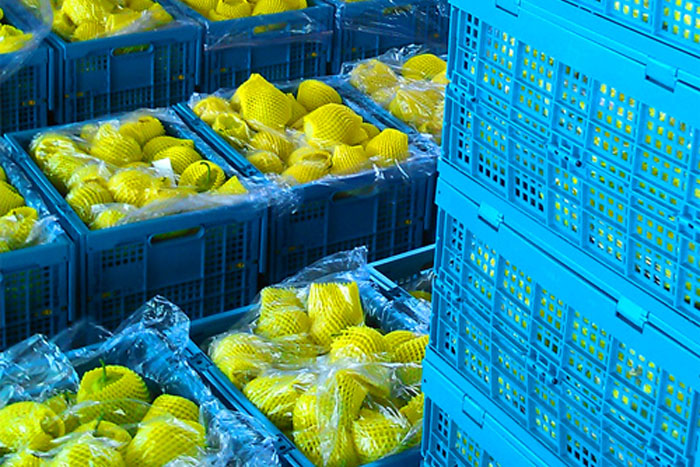
The plastic turnover box for food is generally made of PE or PP, and the product quality m
Learn more >Shandong Junchuang Intelligent Technology CO., LTD
+86-13066013183 (Nonworking Time)
Email Address: tina@sdjcznkj.com
Copyright:Shandong Junchuang Intelligent Technology CO., LTD
Key Word: plastic parts box part box divider foldable plastic warehouse box Stackable Storage Plastic Bin Box Plastic turnover box Plastic Pallet