+86- 13066013183






Industry News, 11-23-2026
Protective packaging sits at the back of the supply chain — the air pillows, foam inserts, bubble wrap, molded fiber and mailers that keep goods intact from warehouse to doorstep. As parcel volumes keep climbing and electronics, glass and cosmetics ship direct to consumers, this once-commodity category is being repositioned from a shipping cost into a brand and damage-rate lever.

Market Size: Broad and Narrow Estimates

Estimates for protective packaging vary widely depending on scope. Global Market Insights puts the market at USD 36.1 billion in 2025, USD 38.4 billion in 2026 and USD 55.8 billion by 2035 at a 4.2% CAGR. Grand View Research estimates USD 40.4 billion in 2025, USD 41.5 billion in 2026 and USD 57.0 billion by 2033 at a 4.6% CAGR. Freedonia reports USD 41.5 billion in 2025 growing 4.5% annually to USD 51.7 billion by 2030. A narrower Mordor Intelligence cut, focused on protective formats only, values the segment at USD 9.73 billion in 2025, USD 10.14 billion in 2026 and USD 12.43 billion by 2031 at a 4.17% CAGR.

Two adjacent formats are growing faster than the broad market. Protective packaging foam is projected at USD 6.05 billion in 2026 toward USD 9.83 billion by 2035 at a 5.6% CAGR. Polyethylene mailers are estimated at USD 3.4 billion in 2025, USD 3.6 billion in 2026 and USD 6.0 billion by 2036 at a 5.3% CAGR, with stationery items holding a 29.0% product share; the USA and South Korea are forecast for the fastest country-level growth at 5.4%.

What Is Driving Demand

Four forces are reshaping protective packaging.

First, e-commerce parcel growth. Every online order needs void fill, cushioning or a mailer bag. Lightweight materials that reduce dimensional-weight fees now matter as much as the cushioning itself, because freight pricing penalizes bulky, low-density packaging.

Second, fragile and high-value goods. Smartphones, laptops, tablets, cosmetics and glass items require shock, vibration and static protection. Custom-molded foam inserts, anti-static bags and reinforced corners are standard practice for premium electronics, and roughly 69% of fragile-goods shipments use foam packaging to prevent transit damage.

Third, the paper and fiber substitution. Regulation and brand sustainability targets are pushing air pillows and foam toward recyclable paper, molded fiber and recycled-content alternatives. Converters that can demonstrate recyclability win the accounts that foam-only suppliers now struggle to keep.

Fourth, the unboxing experience. Protective materials are increasingly visible to the end customer, so branded mailers, color-matched void fill and neat presentation have become a point of differentiation rather than an afterthought.

Outlook

Asia Pacific remains the largest and fastest-growing regional market for protective packaging, combining manufacturing density with the world's fastest parcel growth, while North America and Western Europe steady on mature e-commerce volumes. For suppliers, the fastest-moving openings are lightweight recyclable cushioning, molded fiber for fragile goods, and custom-printed mailers — the formats where e-commerce demand, sustainability rules and brand experience converge. 
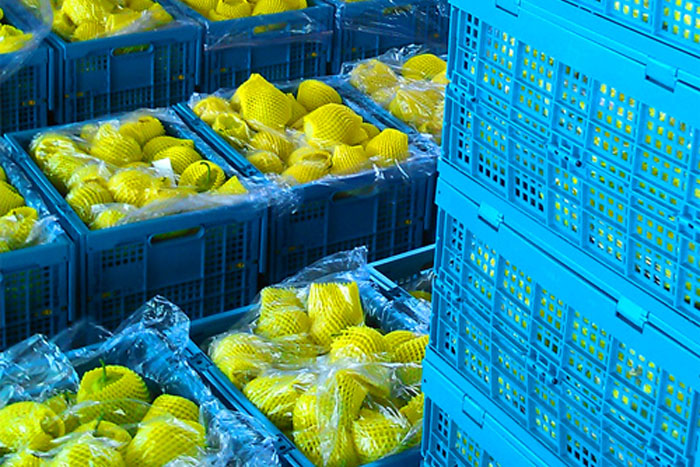
The plastic turnover box for food is generally made of PE or PP, and the product quality m
Learn more >Shandong Junchuang Intelligent Technology CO., LTD
+86-13066013183 (Nonworking Time)
Email Address: tina@sdjcznkj.com
Copyright:Shandong Junchuang Intelligent Technology CO., LTD
Key Word: plastic parts box part box divider foldable plastic warehouse box Stackable Storage Plastic Bin Box Plastic turnover box Plastic Pallet